Written by Jordan Bertram, Owner, Balanced Bodies: Longevity + Wellness Clinic · Medically reviewed by Kent Cohen, MD, FACEP, Medical Director · Last reviewed October 2026
In the largest study to follow patients after they stopped, people regained about two-thirds of the weight they had lost within one year of coming off semaglutide. For tirzepatide the pattern was similar. That is the honest answer, and it is the single most important thing to understand before you start a GLP-1 — not because stopping is a disaster, but because what happens next depends almost entirely on whether anyone planned for it.
Here is what the research actually found, why the weight returns, and what a maintenance plan looks like at our clinic in Marietta.
What happened when patients stopped semaglutide
The STEP 1 trial extension followed participants for a year after semaglutide was withdrawn. During 68 weeks on the medication, the group lost an average of 17.3% of their body weight. One year after stopping, they had regained 11.6 percentage points of it — roughly two-thirds of what they had lost.
They did not end up back where they started. The group was still 5.6% below their original weight, compared with 0.1% for the placebo group. But the share of people holding at least a 5% weight loss fell from 86.4% at the end of treatment to 48.2% a year later.
Blood pressure returned to where it had been before treatment. Inflammatory markers and lipids moved back toward baseline, though they stayed somewhat better than placebo. A number of people whose blood sugar had normalized on the medication drifted back into the prediabetes range.
Read the study: Weight regain and cardiometabolic effects after withdrawal of semaglutide: The STEP 1 trial extension (Wilding et al., Diabetes, Obesity and Metabolism, 2022).
What happened when patients stopped tirzepatide
SURMOUNT-4 was built to answer this question directly. Participants took tirzepatide for 36 weeks and lost an average of 20.9% of their body weight. Those who had lost at least 10% were then split into two groups: half continued the medication for another year, half switched to placebo.
The group that kept taking it lost a further 5.5%. The group that stopped regained 14.0%. By the end of the study, the people who continued were 25.3% below their starting weight and the people who stopped were 9.9% below it.
Among those who stopped, 82% regained more than a quarter of what they had lost, and a little over a fifth regained three-quarters or more.
Why the weight comes back
None of this means the medication stopped working or that the loss was fake. It means the thing that was suppressing appetite is no longer there.
GLP-1 medications work in part by slowing how quickly your stomach empties and by quieting the constant background signalling about food. When the medication clears, both effects fade. Appetite returns, often noticeably, and it returns into a body that now needs fewer calories than it did before — a smaller body burns less at rest, and the longer you have been in a deficit the more pronounced that effect tends to be.
So the hunger comes back up at the same time the body’s requirement goes down. That is a difficult combination to white-knuckle, and the trial data suggest most people do not manage it without a plan.
What these trials do not tell you
We would rather give you the limitations than let you read more into the numbers than they support.
- Both trials stopped the medication abruptly. Participants went from a full therapeutic dose to nothing. That is not how a planned taper works.
- In STEP 1, the lifestyle support was withdrawn too. Participants lost the medication and their structured counselling at the same time. Real-world maintenance usually keeps the support.
- These were high doses of the FDA-approved brand-name products — semaglutide 2.4 mg and tirzepatide 10 or 15 mg. Results from a maximum dose do not automatically describe what happens at a lower maintenance dose.
- The semaglutide extension was exploratory. It followed 327 of the original participants and was not designed for formal statistical testing.
- Regain was not universal. Nearly half of the semaglutide group still held a 5% or greater loss a year out. Averages hide the people who did fine.
What a maintenance plan actually looks like
Coming off a GLP-1 is not a single decision, and it is not all-or-nothing. In practice there are three paths, and the right one depends on your labs, your body composition, and what you are willing to sustain.
Stay on a lower maintenance dose. Many patients hold their results on considerably less medication than it took to lose the weight. This is the most common path and usually the cheapest version of continuing.
Taper off deliberately. Step down over months rather than stopping at a full dose, with resistance training and protein intake in place before the taper starts, not after. This gives you a chance to notice regain early, while it is a few pounds rather than twenty.
Stop and monitor. Some people come off entirely and hold. They are usually the ones who built real strength training habits during the loss phase and kept them. We still want to see you — regain is far easier to address at month two than at month ten.
What all three have in common is that someone is measuring. Stopping without a follow-up plan is the version with the worst outcomes in the data.
The part nobody measures: muscle
Here is the piece that matters most and gets discussed least.
When weight comes off quickly, some of what leaves is lean muscle rather than fat. When it comes back, it tends to come back as fat. Run that cycle once and you can finish at the same number on the scale with a meaningfully worse body composition than you started with — and a lower resting metabolic rate, which makes the next attempt harder.
A bathroom scale cannot see any of this. It reports a pound of muscle and a pound of fat identically.
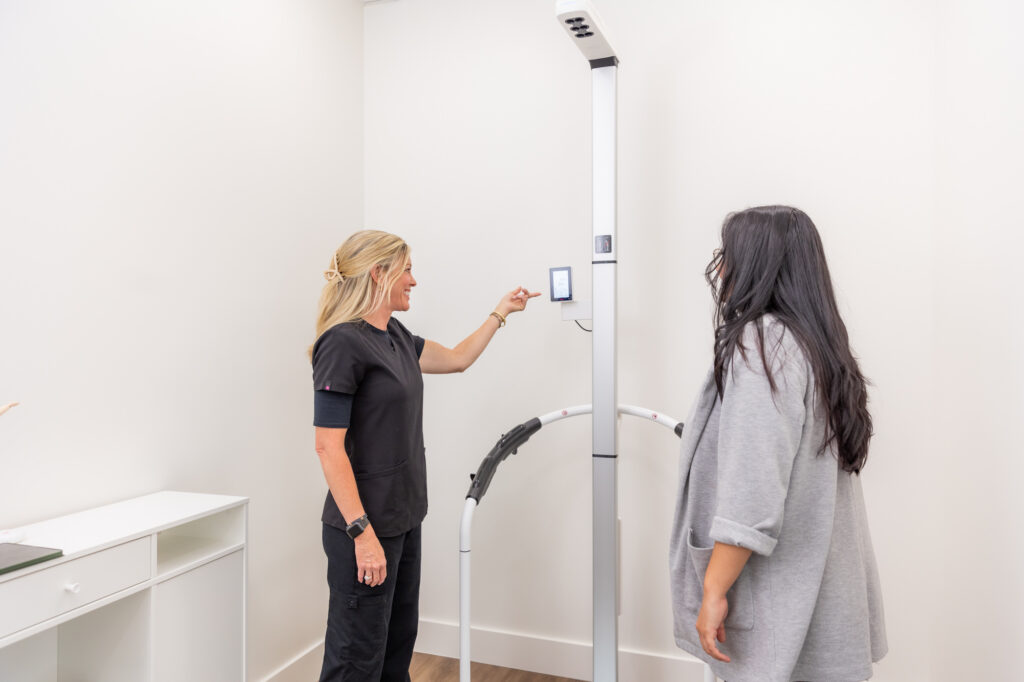
This is why every patient on a weight loss plan at Balanced Bodies gets an InBody body composition scan at each visit, not just a weigh-in. If lean mass is trending down, we would rather find out in month two and respond — protein targets first, resistance training second, dose adjustment last — than discover it after the fact. More on this in our guide to strength training for fat loss.
If you are thinking about stopping
Talk to your provider before you do, and bring specifics: what dose you are on, how long you have been there, what your last body composition scan showed, and what is driving the decision. Cost, side effects, and “I’ve hit my goal” are three different problems with three different answers.
If cost is the reason, say so. At our clinic semaglutide is $199 a month and tirzepatide is $249, both including your provider visits, labs, and InBody scans, with no membership fee and nothing to cancel. A lower maintenance dose is often less than that. Our full pricing is published so you can see the numbers before you book.
If you are already off a GLP-1 and the weight is coming back, that is a common place to be and it is not a failure. It is the predictable result of removing a treatment without replacing it with a plan.
Common questions
Will I gain all the weight back if I stop semaglutide?
Not necessarily all of it. In the STEP 1 trial extension, participants regained about two-thirds of their loss within a year of stopping and remained around 5.6% below their original weight on average. Just under half still held a 5% or greater loss after a year. Regain is common, but it is not universal and it is not immediate.
How long after stopping does the weight start coming back?
Appetite usually returns within a few weeks as the medication clears. Weight change follows more gradually over the months after that. The trials measured outcomes at one year; the curve is a slope, not a cliff.
Can I take a lower maintenance dose instead of stopping completely?
For many patients, yes, and it is the most common approach we use. The right maintenance dose is individual and is something your provider sets based on your history, your labs, and your body composition trend — it is not a fixed fraction of your losing dose.
Is it dangerous to stop a GLP-1 suddenly?
Stopping is not generally hazardous in the way that abruptly stopping some other medications can be, and there is no withdrawal syndrome. The concern is metabolic rather than acute: appetite returns, weight tends to follow, and blood pressure and blood sugar improvements can reverse. If you are on other medications, particularly for diabetes or blood pressure, those may need to be revisited — which is a conversation to have with your provider rather than a decision to make alone.
Do I have to stay on this forever?
No, and we would not frame it that way. Obesity behaves like a chronic condition, which means treatment often continues in some form — but “some form” ranges from a full dose to a low maintenance dose to no medication with monitoring. What the evidence argues against is stopping with no plan and no follow-up.
Do you see patients outside Marietta?
Yes. We are at Barrett Parkway and Dallas Highway and regularly see patients from Kennesaw, Acworth, Powder Springs, Dallas and across West Cobb. Check-ins between visits can be handled by telehealth; the monthly InBody scan is the one that needs you in the building.
Talk it through before you decide
Whether you are starting a GLP-1, thinking about coming off one, or already off and watching the scale move the wrong way, the consultation is free and there is no obligation attached to it. Bring your labs if you have them.
Book Free Consultation or call (678) 919-4845. More about our approach to medical weight loss in Marietta.
This article is for general information and is not medical advice. Decisions about starting, adjusting, or stopping any medication should be made with your own licensed provider. Compounded semaglutide and tirzepatide are prepared by a licensed 503A compounding pharmacy; compounded versions are not FDA-approved and are not generic equivalents of Ozempic, Wegovy, Mounjaro, or Zepbound. The studies described above were conducted using the FDA-approved brand-name products.